
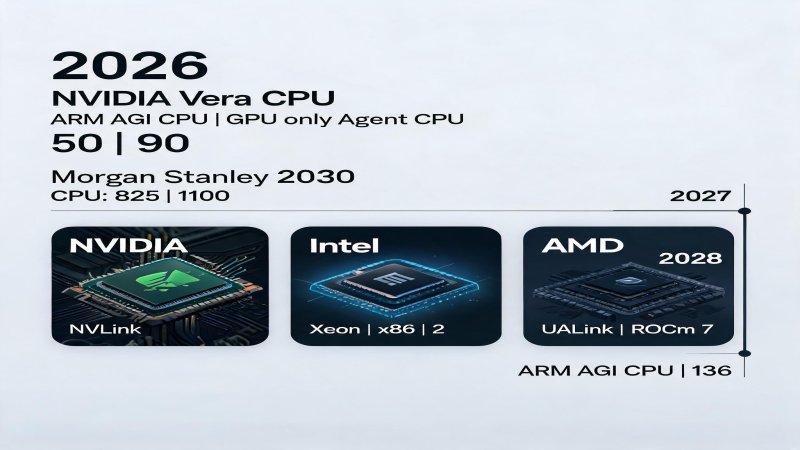
The End of the GPU-Only Era: The March 2026 Inflection Point
March 2026 witnessed two landmark product launches that fundamentally altered the AI infrastructure game. NVIDIA unveiled the Vera CPU at GTC, targeting agent orchestration and reinforcement learning post-training. Two weeks later, ARM released its first self-designed AGI CPU, officially transitioning from an IP licensor to a chip manufacturer. These moves reveal a core trend: the CPU is evolving from GPU's supporting role back to commander.
Morgan Stanley research quantifies this shift: by 2030, the global data center CPU market will reach $82.5-110 billion, with $32.5-60 billion representing incremental demand from Agentic AI. More critically, in multi-step agent tasks, CPU-side processing time accounts for 50-90% of total workload latency. This means GPUs handle thinking while CPUs manage organizing and executing actions - a division of labor being fundamentally redefined.
ARM projections are more aggressive: agent-era data centers will require 4x the CPU core count per gigawatt, growing from 30 million to 120 million cores. As AI shifts from single-shot inference to autonomous multi-step execution, system bottlenecks are migrating from GPUs to CPUs and memory. The historical ratio of one CPU serving 12 GPUs may shift to 1:2, or even 2 CPUs per GPU.
The Three Titans Roadmaps: Three Philosophies, Three Bets
Intel: x86 Fortress Defense Plus NVIDIA Alliance
Intel is undergoing its most profound strategic transformation. Facing marginalization in the AI era, new CEO Lip-Bu Tan chose pragmatism: deep binding with former rival NVIDIA. In September 2025, both parties announced comprehensive strategic cooperation, with NVIDIA investing $5 billion in Intel - the largest external capital infusion in Intel history.
The partnership core is jointly developing a customized Xeon processor with integrated NVLink technology. NVLink is NVIDIA proprietary interconnect protocol, offering far higher CPU-GPU bandwidth than traditional PCIe. Integrating NVLink into Intel Xeon enables more efficient coordination between Intel CPUs and NVIDIA GPUs - an architecture that hyperscale AI computing clusters have long dreamed of. At GTC 2026 in May 2026, Jensen Huang announced Xeon 6 as the exclusive host CPU for the DGX Rubin NVL8 system.
Intel server CPU roadmap is accelerating. Clearwater Forest (H1 2026) features 288 E-cores on Intel 18A process with 12-channel DDR5-8000 memory. Originally slated for 2026, Diamond Rapids has been delayed to 2027, offering up to 256-512 cores with Panther Cove-X architecture and 16-channel MRDIMM Gen2 (1.6TB/s bandwidth). Diamond Rapids will be the last Xeon generation without SMT, while Coral Rapids (2028) reintroduces the technology.
However, Intel faces severe challenges. Falcon Shores GPU project has been cancelled, and the Gaudi accelerator series has reached its end - meaning Intel has essentially abandoned competing with NVIDIA and AMD in AI accelerators. Supermicro and Intel March 2026 hybrid deployment whitepaper explicitly recommends Xeon 6 for 8B parameter models while 405B models run on Gaudi 3 - but Gaudi future remains doubtful. In SambaNova and Intel April 2026 heterogeneous solution showcase, GPUs handle prefill, RDU does decode, and Xeon 6 focuses on agent orchestration and tool calling - pragmatic but limited.
AMD: Open Ecosystem, Full-Stack Self-Development
AMD chose a radically different path: building a completely open ecosystem. EPYC Turin (Zen 5) is already in mass production with 192 cores on 3nm. The next-generation EPYC Venice (Zen 6) launches 2026-2027 with 256 cores, 1.7x generational performance improvement, and 1.6TB/s memory bandwidth. AMD jumped directly to 2nm process, injecting powerful momentum into the competition.
AMD AI infrastructure core is the Helios rack solution, integrating EPYC Venice CPU, MI400 GPU (432GB HBM4, 19.6TB/s bandwidth, 40 PFLOPS FP4 compute), Pensando Vulcano AI NIC, plus UALink open interconnect and UltraEthernet network standards. Against NVIDIA NVLink+NVSwitch closed ecosystem, AMD bets on the appeal of open standards - enterprise customers are increasingly wary of single-vendor lock-in.
AMD software offensive is equally fierce. ROCm 7 delivers 4.6x inference performance and 3x training performance improvements over ROCm 6. More strategically, ROCm 7 introduces Windows support for the first time, and the developer ecosystem is expanding rapidly. At AMD 2025 Financial Analyst Day, the company disclosed that seven of the world top ten AI companies now deploy AMD Instinct accelerators at scale. Morgan Stanley research shows that among 2025 CS graduates, ROCm proficiency reached 38%, surpassing CUDA 35% - an early signal that CUDA dominance may be shaken.
However, AMD has vulnerabilities. Despite MI400 50% memory capacity advantage over NVIDIA Vera Rubin (432GB vs 288GB), its scale-up interconnect bandwidth (300 GB/s) remains far lower than NVLink-C2C 1.8TB/s. In scenarios requiring extreme CPU-GPU communication, AMD solution may be disadvantaged.
ARM: The Disruptor Ambition
ARM choice is the most aggressive: building its own chips. On March 24, 2026, ARM launched the AGI CPU - its first self-designed, directly marketed mass-produced chip in 35 years. With 136 Neoverse V3 cores on TSMC 3nm N3P process, 6GB/s memory bandwidth per core, sub-100ns latency, and 300W TDP - this is a processor purpose-built for agent workloads.
ARM design philosophy differs sharply from x86. The AGI CPU has no SMT; each core runs a single dedicated thread, delivering deterministic performance under sustained load and eliminating x86 turbo throttling issues. The 12-channel DDR5-8800 memory architecture provides 6GB/s bandwidth per core, ensuring high-bandwidth demands for large model inference and multi-agent scheduling.
Rack-level density is ARM core selling point. Air-cooled versions deploy 8,160 cores per rack; liquid-cooled versions reach 45,696 cores per rack. ARM claims 2x+ performance per rack versus x86 platforms, potentially saving $10 billion in CAPEX per GW of AI data center capacity. If fulfilled, this promise will profoundly impact data center economics.
Meta is the AGI CPU lead partner and co-developer, planning to deploy it alongside their self-developed MTIA training inference accelerator. The partner list gleams: OpenAI, Cerebras, Cloudflare, SAP, SK Telecom, and more. In May 2026, ARM disclosed that just six weeks after AGI CPU launch, 2027-2028 fiscal year customer intent orders surged from $1 billion to over $2 billion - enthusiastic market response, but capacity remains the sole bottleneck. First shipment revenue is expected in Q4 FY2027.
ARM roadmap is equally ambitious. CSS V4 and AGI CPU Gen 2 launch in 2027; future versions will support NVLink, potentially making ARM a CPU option within the NVIDIA ecosystem competing directly with x86. This is a bet that could reshape the entire industry structure.
NVIDIA Vera: The Fourth Player Fusion Philosophy
NVIDIA Vera CPU is the fourth player that demands separate discussion. 88 custom Olympus cores (ARM v9.2-based), 176 threads (Spatial Multithreading), 1.5TB LPDDR5X SOCAMM2 memory, 1.2TB/s bandwidth - Vera represents NVIDIA philosophy of on-chip fusion at its extreme.
Vera Spatial MT technology allows each core to run two tasks simultaneously - not traditional SMT time-sharing, but physically dividing pipelines, caches, and registers so each thread has dedicated resources. Paired with NVLink-C2C 1.8TB/s direct connection to Rubin GPUs, the CPU is no longer an independent selection but the control plane of a GPU superchip.
Vera rack configuration: 256 liquid-cooled processors, 45,056 threads, 22,500+ concurrent environments running simultaneously. Benchmark data shows Vera is 50% faster than competing platforms in RL post-training and agentic sandbox scenarios, with 2x performance-per-watt over x86 solutions. This confirms NVIDIA core thesis: in the agent era, the CPU bottleneck is limiting entire system efficiency.
Collision of Three Philosophies: Predictions and Risks
These three companies are essentially betting on what kind of computing philosophy the agent era requires. Intel bets on compatibility: x86 software ecosystem built over 40 years makes migration costly, and enterprises still need to run massive existing applications. AMD bets on openness: NVIDIA closed ecosystem is their biggest weakness; UALink+UEC gives enterprises a second choice. ARM bets on a new starting point: agents are new workloads that do not need x86 legacy baggage; energy efficiency density determines rack economics.
Short-term (2026-2027): Intel x86 remains mainstream, but AMD penetration in AI data center incremental market will accelerate; ARM AGI CPU is a customization option for Meta and similar giants, with mass adoption requiring more time.
Mid-term (2027-2028): After ARM AGI CPU Gen 2 plus NVLink support, it could become NVIDIA ecosystem CPU choice - reshaping the entire competitive landscape. If Intel+NVIDIA customized NVLink Xeon succeeds, it represents the best answer for securing existing market.
Ultimate question: Will agent-era operating systems and runtimes (like MAF, LangGraph) naturally favor ARM? Just as Linux helped ARM server penetration during the cloud era, these emerging frameworks architectural choices could become ARM critical variable.
Vulnerability Analysis: Three-Factor Perspective
Traditional problems: x86 power efficiency has always been suppressed by ARM; ARM software ecosystem, though improving, remains weaker than x86; AMD CPU-GPU interconnect bandwidth (300 GB/s) is far lower than NVLink 1.8TB/s.
Agent attack surface: Agent orchestration requires deterministic latency - x86 turbo throttling is a hidden risk. When temperature rises or power hits limits, performance dynamically degrades, which is problematic for agent workloads requiring stable SLAs. ARM no-SMT design may lack sufficient total threads in highly multi-threaded agent scenarios (like processing thousands of concurrent requests simultaneously).
Defense directions: Intel needs NVLink Xeon to prove x86 is irreplaceable in AI scenarios; AMD needs Helios rack delivery to prove the open ecosystem is viable; ARM needs AGI CPU mass production to prove density advantages are real - orders have reached $2 billion, but manufacturing capability remains unknown.
Conclusion: The CPU Revenge
Over the past five years, the AI infrastructure narrative has been almost entirely about GPUs. But as AI shifts from generation to execution, from answering questions to completing tasks, the nature of computing changes. Agents require planning, reasoning, tool calling, state management - these are all the CPU job.
This is not the GPU twilight; it is the CPU renaissance. Three companies respond to the same opportunity with completely different philosophies: Intel chooses alliance with NVIDIA, trading compatibility for ecosystem; AMD chooses open standards, fighting closed systems with full-stack self-development; ARM chooses to overturn the board, redefining rack economics with energy efficiency density. 2027-2028 will be the pivotal moment to test these bets.
Regardless of who ultimately wins, one thing is certain: the CPU is no longer just supporting infrastructure for GPUs but the core bottleneck determining AI system performance and efficiency. The value of this shift will be repriced by the entire industry.
Why it Matters
Agentic AI is reshaping the core logic of data center infrastructure. As AI shifts from single-shot generation to multi-step autonomous execution, the CPU role transforms from GPU assistant back to system commander. Three companies respond with radically different strategies:
Intel chose alliance with NVIDIA, trading a $5B investment for NVLink Xeon cooperation - a pragmatic choice to defend x86 against ARM erosion. AMD bets on open standards; the Helios rack+ROCm 7 combination is shaking CUDA dominance. ARM took the most aggressive path, building its own chip; AGI CPU $2B orders in six weeks proves the market recognizes its energy efficiency density story.
More importantly, NVIDIA Vera CPU launch proves that even the GPU king believes the CPU bottleneck is limiting AI system efficiency. This cognitive shift will redefine investment direction for the entire industry.
DECISION
For data center planners: Intel x86 ecosystem remains viable short-term, but closely monitor AMD penetration in AI incremental markets; evaluate ARM AGI CPU cost-effectiveness in specific scenarios (e.g., high-density agent deployment).
For AI infrastructure investors: NVLink Xeon and Helios delivery timelines are key indicators. If NVIDIA+Intel cooperation succeeds, x86 lifespan in AI scenarios extends significantly; if ARM AGI CPU Gen 2+NVLink launches on schedule, the industry structure could be reshaped.
For developers: ROCm ecosystem maturity has significantly improved; 2025 graduates ROCm proficiency surpassed CUDA for the first time. New projects can consider AMD as a second choice.
PREDICT
Short-term (2026-2027): Intel x86 remains mainstream but growth stagnates; AMD rapidly penetrates AI data center incremental markets; ARM AGI CPU is a customization option.
Mid-term (2027-2028): ARM AGI CPU Gen 2+NVLink support may make it a NVIDIA ecosystem CPU choice; Intel+NVIDIA NVLink Xeon success could stabilize existing market; x86 vs ARM market share will see substantial structural changes.
Key variables: Whether ARM software ecosystem matures rapidly; whether AMD Helios rack delivers on schedule; whether NVIDIA Vera NVLink-C2C interconnect becomes a de facto standard. These three variables evolution will determine the final landscape.
Get 3-5 key AI infrastructure signals weekly →
💬 Comments (0)