
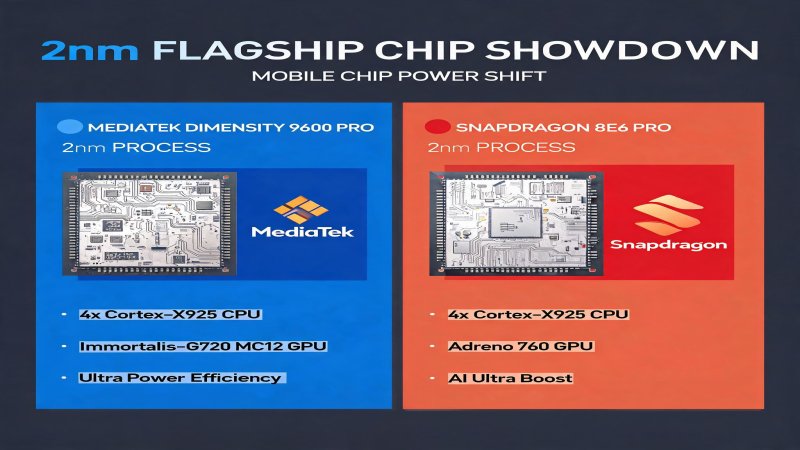
MediaTek Dimensity 9600 Pro vs Snapdragon 8E6 Pro: 2nm Flagship Chip Architecture Showdown and the Mobile Chip Power Shift
1. Event Recap: September Dual Flagship Launch, 2nm Era Begins
On July 20, 2026, leaker Digital Chat Station revealed that MediaTek's Dimensity 9600 series will launch in September, featuring both a standard and Pro variant. This coincides with Qualcomm's Snapdragon 8E6 series targeting the same launch window, making September 2026 the most compelling flagship chip showdown in mobile history.
Dimensity 9600 Series Lineup:
- Dimensity 9600 (Standard): TSMC 3nm process, enhanced Dimensity 9500 variant, positioned as sub-flagship
- Dimensity 9600 Pro: TSMC second-generation N2P 2nm process, MediaTek's first 2nm smartphone SoC, positioned as true flagship
First devices: vivo X500 series and OPPO Find X10 series will debut Dimensity 9600 series. Xiaomi 18 series will debut Snapdragon 8E6 Pro.
This is not an ordinary annual iteration. It marks the first time MediaTek and Qualcomm compete head-to-head on the same TSMC 2nm process node. Previously, MediaTek typically lagged Qualcomm by one generation in process technology — Dimensity 9300 caught up with 4nm, but Dimensity 9400 arrived slightly later than Snapdragon 8 Elite on 3nm. Now, with both launching simultaneously on N2P 2nm, performance gaps will be determined entirely by architecture design, with no process advantage to lean on.
Meanwhile, at MediaTek Tech Day in New Delhi on July 20, the company showcased its One MediaTek strategy — expanding from smartphone chips to automotive (Dimensity AX), data centers, and AI PCs (Dimensity CX). India market share stands at 49% for 24 consecutive quarters. Dimensity 9600 Pro is the flagship declaration of this strategy.
2. Technical Deep Dive: Architecture Differences Between Two 2nm Flagships
2.1 Process Technology: Same Node, Different Implementations
Both use TSMC N2P (second-generation 2nm), an enhanced version of N2 with Backside Power Delivery (BSPDN). N2P delivers further power and density optimization over N2, representing TSMC's second production node on GAA transistor architecture.
The critical difference lies not in the process itself, but in who better exploits N2P's characteristics. N2P's high-density logic cells can accommodate more transistors, but each vendor's physical design strategy (cell placement, power delivery network, clock tree design) significantly impacts final performance.
2.2 CPU Architecture: ARM Cortex C2-Ultra vs Custom Oryon
This is the fundamental architectural divergence:
| Dimension | Dimensity 9600 Pro | Snapdragon 8E6 Pro |
|---|---|---|
| CPU Architecture | ARM Cortex C2-Ultra + C2-Premium + C2-Pro | 3rd-gen Oryon custom |
| Core Layout | 2+3+3 tri-cluster | 2+3+3 tri-cluster |
| Prime Cores | 2× C2-Ultra, ~5.0GHz | 2× Oryon Prime, ~4.6GHz |
| Performance Cores | 3× C2-Premium | 3× Oryon Performance |
| Efficiency Cores | 3× C2-Pro | 3× Oryon Efficiency |
| L2 Cache | 256KB×2 (prime) + perf + eff | 16MB total (incl. shared L2) |
| L3/LLC | TBC | 8MB LLC |
The architectural choice explained:
- ARM C2-Ultra is ARM's latest high-performance core for 2026, optimized for 2nm. Microarchitecture improvements include wider decode width (likely 10-wide+), deeper out-of-order execution window, and enhanced branch predictor. Pushing to ~5GHz suggests ARM achieved a breakthrough in public core frequency potential — previously, ARM Cortex cores in smartphones rarely exceeded 4.5GHz.
- 3rd-gen Oryon continues Qualcomm's post-Nuvia acquisition custom architecture iteration. Oryon differentiates through its server-class heritage (Nuvia Phoenix), inheriting wide-issue, large-cache, high-IPC design philosophy. The frequency cap at ~4.6GHz hints that Oryon faces different thermal density challenges on 2nm than ARM's public core.
The core question: Can 5GHz ARM C2-Ultra match 4.6GHz Oryon in IPC? If C2-Ultra achieves 90%+ of Oryon's IPC, the frequency advantage translates directly to single-core performance leadership.
2.3 GPU Architecture: ARM Magni vs Adreno 850
| Dimension | Dimensity 9600 Pro | Snapdragon 8E6 Pro |
|---|---|---|
| GPU Core | ARM Magni GPU | Adreno 850 |
| Dedicated Graphics Cache | TBC | 18MB GMEM |
| Hardware Frame Generation | Yes | TBC |
| Native Resolution Scaling | Yes | TBC |
| Ray Tracing | Hardware-level | Hardware-level (3rd gen) |
Another watershed in GPU strategy:
- ARM Magni GPU is ARM's brand-new 2026 GPU architecture, introducing hardware-level frame generation to mobile for the first time (similar to NVIDIA DLSS 3 Frame Generation and AMD FSR 3). In gaming, GPU renders half the frames while AI interpolates the other half, theoretically doubling frame rate without significant power increase. Native resolution scaling enables rendering at lower resolution with AI upscaling to high resolution output, reducing GPU load.
- Adreno 850 continues Qualcomm's traditional mobile GPU dominance. The 18MB dedicated graphics memory (GMEM) is the standout feature — 50% more than the standard Snapdragon 8E6's 12MB. Large cache significantly reduces system memory bandwidth pressure in high-resolution gaming (1440p+), lowering power and heat.
The critical question: Is ARM Magni GPU's hardware frame generation a genuine game-changer or marketing hype? It depends on whether frame generation latency is imperceptible (sub-10ms) and game ecosystem adaptation speed. Adreno 850's 18MB cache represents extreme optimization on the traditional GPU path, with the advantage of an instantly mature ecosystem.
2.4 AI Acceleration: NGP+SME2 vs Hexagon
Dimensity 9600 Pro features the NGP Neural Acceleration Unit with SME2 (Scalable Matrix Extension 2) instruction set support. SME2 is a critical ARM v9 extension designed for matrix operation acceleration, significantly boosting matrix multiplication performance in AI inference and training.
Snapdragon 8E6 Pro features the next-generation Hexagon AI Engine, with years of Qualcomm AI processing expertise and mature INT8/INT4 inference acceleration.
Key difference: Dimensity 9600 Pro's SME2 operates at the CPU level for matrix acceleration, enabling heterogeneous computing alongside GPU and NPU. Hexagon is a dedicated AI accelerator. Both approaches have merits — SME2 offers greater flexibility (benefiting both AI and non-AI workloads), while Hexagon's specialization delivers higher AI-specific efficiency.
2.5 Memory and Storage: LPDDR6/UFS 5.0 First-Mover Advantage
This is Dimensity 9600 Pro's most aggressive product definition decision:
| Dimension | Dimensity 9600 Pro | Snapdragon 8E6 Pro | Snapdragon 8E6 (Standard) |
|---|---|---|---|
| Memory | LPDDR6 | LPDDR6 | LPDDR5X |
| Storage | UFS 5.0 | UFS 5.0 | UFS 4.0 (estimated) |
LPDDR6 delivers 30-50% bandwidth improvement over LPDDR5X — a critical bottleneck eliminator for on-device LLM inference (e.g., 7B parameter models). UFS 5.0 read speeds can reach 2x+ of UFS 4.0, dramatically reducing model load times.
Snapdragon 8E6 standard limited to LPDDR5X is the cost of Qualcomm's product segmentation — reserving LPDDR6 for the Pro variant means mid-range flagships will face AI performance constrained by memory bandwidth. If Dimensity 9600 Pro ships LPDDR6 across all SKUs, it creates a generational advantage in the premium mid-range segment.
3. Product Logic: MediaTek's Premium Ascent Path
3.1 Five-Year Climb from Dimensity 9000 to 9600 Pro
MediaTek's premium market journey spans three phases:
- 2021-2022 (Dimensity 9000/9200): First entry into flagship, but GPU performance, imaging ISP, and gaming ecosystem lagged behind Snapdragon
- 2023-2025 (Dimensity 9300/9400/9500): Gradually closed core performance gaps, built advantages in AI and efficiency, established vivo X series and OPPO Find series as stable partners
- 2026 (Dimensity 9600 Pro): First simultaneous process node launch, surpassing or matching Snapdragon 8E6 Pro across CPU frequency (5GHz), GPU (hardware frame gen), and memory (LPDDR6)
3.2 One MediaTek Strategy's Flagship Anchor
MediaTek Tech Day's One MediaTek strategy positions Dimensity 9600 Pro as the brand anchor spanning smartphones, automotive, AI PCs, and data centers:
- Automotive (Dimensity AX): 20+ automaker partnerships, 190+ projects; Dimensity 9600's AI compute is a core smart cockpit selling point
- AI PC (Dimensity CX): Competing against Qualcomm Snapdragon X Elite; Dimensity 9600's ARM architecture scales to laptops
- Data Center: MediaTek is exploring ARM-based server chips; Dimensity's AI acceleration technology serves as technical reserve
India's 49% market share over 24 consecutive quarters provides the volume base to invest more R&D in premium chips.
4. Strategic Depth: Mobile Chip Power Shift
MediaTek vs Qualcomm Flagship Chip Comparison Matrix
| Dimension | Dimensity 9600 Pro | Snapdragon 8E6 Pro | Assessment |
|---|---|---|---|
| Process | TSMC N2P | TSMC N2P | Tie |
| CPU Architecture | ARM C2-Ultra (reference) | Oryon 3rd-gen (custom) | Different strengths |
| Prime Core Frequency | ~5.0GHz (lead) | ~4.6GHz | Dimensity leads |
| GPU Architecture | ARM Magni (new) | Adreno 850 (mature) | Needs benchmarking |
| GPU Differentiation | HW frame gen + native upscaling | 18MB GMEM cache | Different approaches |
| AI Accelerator | NGP + SME2 | Hexagon AI Engine | Different strengths |
| Memory | LPDDR6 (all SKUs) | LPDDR6 (Pro only) | Dimensity leads |
| Storage | UFS 5.0 | UFS 5.0 | Tie |
| ISP | Imagiq new-gen | Spectra new-gen | Needs benchmarking |
| Modem | M80 5G | X85 5G | Snapdragon traditional advantage |
| First Devices | vivo X500/OPPO Find X10 | Xiaomi 18 series | Tie |
| Gaming Ecosystem | Catching up | Traditional advantage | Snapdragon leads |
| OEM Breadth | 49% India share | Global flagship default | Different strengths |
Key Variables in Competitive Dynamics
1. ARM Reference Architecture's Maturity Inflection Point
ARM C2-Ultra is the culmination of ARM's continuous v9 architecture iteration. If C2-Ultra approaches or exceeds Oryon in IPC and efficiency, Qualcomm's custom architecture ROI comes into question — why spend billions acquiring Nuvia and maintaining a custom roadmap if ARM's reference designs are good enough?
2. GPU Ecosystem Adaptation Speed
ARM Magni GPU's hardware frame generation is a technical highlight, but requires game developers to actively adapt. In contrast, Adreno 850 benefits from Qualcomm's decade-plus mobile gaming ecosystem — developer toolchains and optimization experience are far more mature. If ARM Magni launches with fewer than 10 supported games, hardware frame generation's real-world value will be severely limited.
3. MediaTek's Premium Brand Ceiling
Despite Dimensity 9300/9400/9500 approaching or exceeding equivalent Snapdragon generations in performance, consumer perception of "flagship = Snapdragon" remains. The success of vivo X500 and OPPO Find X10 will largely determine whether Dimensity 9600 Pro can break through this brand ceiling.
5. Challenges and Risks
1. ARM Magni GPU Ecosystem Risk
ARM GPU's mobile market share is far below the established Adreno/Mali landscape. Magni as a brand-new architecture requires time to adapt with mainstream game engines (Unity, Unreal Engine). Compatibility issues or below-expectation performance at launch would severely impact OEM and consumer confidence.
2. 5GHz Ultra-High Frequency Sustained Performance
~5GHz CPU frequency under smartphone thermal constraints is an extreme challenge. Peak performance may only be achievable during cold starts, with inevitable throttling under sustained load. If Dimensity 9600 Pro's "5GHz" can only be maintained for seconds in Geekbench single-core tests, the real-world gap with Snapdragon 8E6 Pro narrows dramatically.
3. Snapdragon 8E6 Pro's Hidden Advantage
Snapdragon 8E6 Pro's 18MB GMEM is an underappreciated advantage in high-resolution and ray tracing scenarios. If real-world gaming benchmarks show Adreno 850 achieving equivalent frame rates at lower power through its large cache, ARM Magni's hardware frame generation advantage will be neutralized.
4. Multi-Polar Competitive Landscape
Beyond MediaTek and Qualcomm, Samsung Exynos 2600 (rumored custom GPU), Google Tensor G6 (TSMC-fabbed), and Huawei Kirin (if returning) are all competing for premium market share. Dimensity 9600 Pro's competition isn't just Snapdragon 8E6 Pro — it's the entire 2026-2027 flagship SoC landscape.
6. Conclusion
The Dimensity 9600 Pro vs Snapdragon 8E6 Pro competition marks mobile chips entering a "post-process-gap" era. When both launch simultaneously on the same N2P 2nm node, performance gaps are no longer determined by "who gets the new process first" but by "who designed the better architecture."
For smartphone OEMs, this transforms chip selection from "default Snapdragon" to a genuinely strategic technical decision:
- For peak CPU single-core: Dimensity 9600 Pro's 5GHz C2-Ultra leads in frequency, but Oryon's IPC advantage may compensate
- For on-device AI: Dimensity 9600 Pro's SME2 + LPDDR6 + UFS 5.0 full-stack provides system-level advantage in local LLM scenarios
- For gaming ecosystem: Snapdragon 8E6 Pro's Adreno 850 + 18MB GMEM maintains advantage in mature gaming ecosystem
- For cost-effectiveness: Dimensity 9600 Pro's LPDDR6 across all SKUs may create competitive differentiation in the $400-700 price band
For MediaTek, Dimensity 9600 Pro is the pivotal product in its transition from "challenger" to "equal competitor" in the premium market. If Dimensity 9600 Pro's Geekbench single-core score surpasses Snapdragon 8E6 Pro and GPU gaming benchmarks hold their ground, MediaTek will achieve full parity with Qualcomm in flagship for the first time.
For Qualcomm, Snapdragon 8E6 Pro is the moment to prove custom Oryon architecture's long-term value. If 3rd-gen Oryon at 4.6GHz still maintains single-core leadership, the custom route's ROI is validated. If surpassed by ARM C2-Ultra at 5GHz, Qualcomm faces the strategic question: "Should we return to ARM reference cores?"
The mobile chip power structure will be revealed in September 2026.
Why it Matters
The Dimensity 9600 Pro vs Snapdragon 8E6 Pro rivalry represents the most fundamental restructuring of mobile chip power dynamics in a decade:
- Same node, different architectures: For the first time, both compete on identical TSMC N2P 2nm, making performance gaps purely architecture-driven
- ARM Cortex vs custom Oryon: The most critical battle between ARM reference designs and custom architectures in flagship SoCs since Huawei Kirin. Dimensity 9600 Pro maximizes ARM's C2-Ultra ceiling; Snapdragon 8E6 Pro bets on Oryon differentiation
- LPDDR6/UFS 5.0 first-mover advantage: Dimensity 9600 Pro fully supports LPDDR6+UFS 5.0; standard Snapdragon 8E6 only supports LPDDR5X — memory and storage bandwidth directly impact on-device AI model performance
- 49% India market share momentum: MediaTek's 24-consecutive-quarter India dominance provides volume leverage for its premium flagship assault
DECISION
OEM Procurement Decisions
- For peak on-device AI: Dimensity 9600 Pro's NGP accelerator + SME2 + LPDDR6/UFS 5.0 stack provides first-mover advantage in local LLM inference
- For gaming/graphics: Needs real-world benchmarking of ARM Magni GPU (hardware frame gen) vs Adreno 850 (18MB dedicated cache) for frame rates and power efficiency
- For cost differentiation: Snapdragon 8E6 standard uses LPDDR5X — if Dimensity 9600 Pro's BOM cost is competitive, it can differentiate in the $500-700 price band
Chip Selection Technical Assessment
- Single-core CPU: Dimensity 9600 Pro's C2-Ultra at ~5GHz leads Snapdragon 8E6 Pro's ~4.6GHz in frequency, but Oryon's custom IPC may be higher — Geekbench validation needed
- Multi-core: Both use 2+3+3 tri-cluster; key differentiator is scheduler algorithm and cache hierarchy
- AI inference: Dimensity 9600 Pro's SME2 instruction set is a key matrix acceleration differentiator, but framework adaptation (TF Lite, ONNX Runtime) progress needs assessment
PREDICT
- Sep 2026: Dimensity 9600 Pro launches on vivo X500/OPPO Find X10, Snapdragon 8E6 Pro on Xiaomi 18. First Geekbench/Antutu scores will be the critical validation point
- Q4 2026: Dimensity 9600 Pro likely beats Snapdragon 8E6 Pro in single-core Geekbench (5GHz vs 4.6GHz), but Adreno 850 may maintain GPU gaming lead with 18MB cache
- H1 2027: Dimensity 9600 series may grow premium ($600-900) market share from ~15% to 25%+, achieving near-parity with Snapdragon in high-end for the first time
- Q2 2027: MediaTek India market share may break 50%, with Dimensity 9600 series accelerating penetration in Southeast Asian and European mid-to-high-end markets
Get 3-5 key AI infrastructure signals weekly →
💬 Comments (0)