
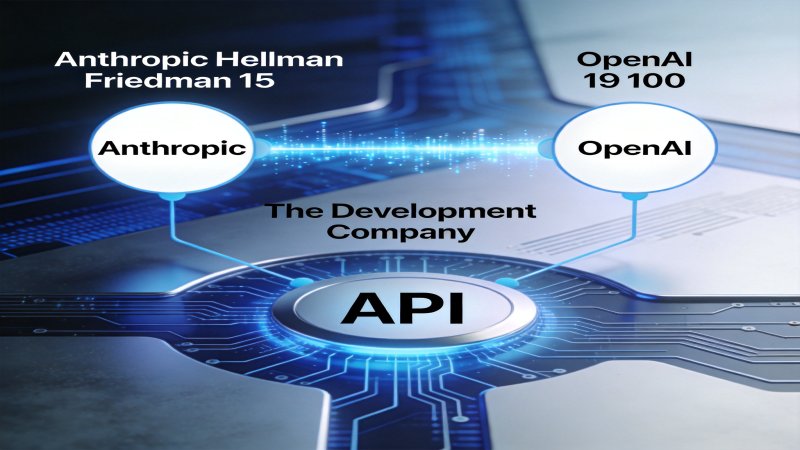
Event Recap: Two JVs Announced on the Same Day
In late April 2026, a milestone moment occurred in the AI industry: Anthropic and OpenAI, within 48 hours of each other, announced their respective enterprise joint venture plans. These two deals not only differ dramatically in scale but also reflect fundamentally different development strategies and business philosophies between the two AI giants.
Anthropic's Capital Strategy: Anthropic announced a joint venture with Blackstone, Goldman Sachs, and private equity giant Hellman & Friedman, creating a $1.5 billion partnership. The core logic of this JV is to deeply embed Anthropic's AI capabilities into investee companies' business processes, distributing AI capabilities through deep customization rather than standardized interfaces.
OpenAI's Ecosystem Ambition: OpenAI partnered with TPG, Brookfield, and 18 other top asset management firms to establish a $10 billion joint venture called "The Development Company." This company's positioning is closer to an enterprise-grade AI service platform, aimed at providing large enterprises with full-stack services from model access to custom development.
Announced in the same month with nearly 7x scale difference—do these two fundamentally different JV models represent the future of AI distribution?
Model Breakdown: Industrial Capital Integration vs Enterprise Service Platform
Anthropic Model: Deep Business Process Integration
Anthropic's JV with Blackstone/Goldman/Hellman & Friedman is essentially an "industrial capital integration" strategy with these core characteristics:
Deep Integration: Anthropic's AI capabilities are not delivered as independent tools but deeply embedded into core business processes. For example, in financial services scenarios, Claude might be directly integrated into investment banks' investment decision systems and risk assessment models, rather than merely as a callable API interface.
Shared Interests: Anthropic doesn't simply sell technology licenses but shares long-term growth benefits with partner companies through the JV structure. This model creates a tighter interest community between Anthropic and its partners.
Strategic Synergy: Blackstone and Goldman Sachs' participation means Anthropic gains strategic access to core systems of top financial institutions. This channel value far exceeds pure sales revenue.
OpenAI Model: Full-Stack Enterprise Service Platform
OpenAI's The Development Company represents another path—the "enterprise service platform" model:
Standardized Services: The $10 billion JV scale means OpenAI can build standardized enterprise service frameworks, including model customization, workflow automation, and integrated development service modules.
Scale Capability: The participation of 19 asset management companies provides not only capital but also an extensive enterprise customer network. TPG and Brookfield manage over $1 trillion in assets globally, with their portfolio companies spanning all industries.
Ecosystem Lock-in: Through deep service integration, OpenAI can establish stronger customer lock-in than API sales. Once enterprises build core business systems on the OpenAI platform, migration costs will increase significantly.
Business Logic: Why API Sales Are No Longer Sufficient
The API sales model was once the mainstream path for AI commercialization, but this model is now facing growth bottlenecks:
| Dimension | API Sales Model | Industrial Capital Integration Model |
|---|---|---|
| Customer Relationship | Loose, Replaceable | Tight, Hard to Migrate |
| Revenue Sustainability | Vulnerable to Price Wars | Tied to Customer Growth |
| Deep Data Access | Cannot Obtain | Can Deeply Participate |
| Competitive Moat | Thin (Model Capabilities Substitutable) | Thick (Deep Business Process Integration) |
| Valuation Multiples | Limited | Significantly Higher |
The Vicious Cycle of Price Wars: With converging model capabilities, API price wars have become inevitable. The LLM price war triggered by GPT-4o's release has proven that business models relying solely on model capability differentiation cannot sustain.
Re-recognizing Data Value: Continuous AI model improvement requires data, but the API sales model creates a barrier between AI vendors and end users, preventing access to deep business data. The industrial capital integration model allows Anthropic to deeply participate in customers' business processes, gaining valuable training data feedback.
Differences in Customer Lock-in: The switching cost for API calls is extremely low, while AI solutions deeply integrated into business processes become significantly more costly to migrate once deployed. This is crucial for AI vendors' long-term revenue stability.
Competitive Landscape: What $1.5B vs $10B Signifies
Strategic Implications of Scale Differences
The $10 billion versus $1.5 billion scale difference reflects not just a difference in capital but also a divergence in strategic positioning:
OpenAI's "Platform" Ambition: The $10 billion JV scale means OpenAI is betting on the strategic direction of "AI infrastructure platform." This follows the same logic as Microsoft's investment in OpenAI—not pursuing profit margins per transaction but pursuing platform network effects and ecosystem control.
Anthropic's "Boutique" Route: Although smaller at $1.5 billion, Anthropic can build deeper moats in more vertical domains. Partnerships with Blackstone/Goldman Sachs give Anthropic strategic depth in financial services that other AI vendors cannot easily replicate.
Underlying Valuation Logic Differences
Anthropic's latest valuation stands at approximately $90 billion, while OpenAI reaches approximately $852 billion. This valuation gap isn't solely caused by scale differences but reflects capital markets' differentiated pricing of two business models:
- OpenAI's Platform Model: High valuation based on imagination space for network effects and ecosystem control
- Anthropic's Deep Integration Model: Relatively lower valuation reflects capital markets' concerns about growth ceiling for the "boutique" route
Notably, if Anthropic can establish irreplaceable advantages in specific verticals (such as finance and healthcare), its valuation multiples could significantly improve.
Impact on Industry Chain
Potential Impact on SMEs
The deepening of both JV models may bring a concerning trend: deeply customized AI services may become exclusive privileges for large clients.
Resource Barriers: JV scales of $1.5 billion or even $10 billion mean only enterprises capable of participating at this level can access the highest quality AI services. SMEs may only have access to standardized, low-cost API services.
Capability Gaps: Large enterprises will gain significant efficiency advantages through deeply customized AI systems, while SMEs may face competitive disadvantages due to lack of customization capabilities. This "AI divide" may exacerbate market concentration.
Service Accessibility: Anthropic's model of embedding itself in investee companies' business processes means non-portfolio enterprises in the same industry may not have access to the same service levels. This selective service may trigger antitrust concerns.
Potential Impact on AI Industry Landscape
- Vertical Integration Accelerates: The Anthropic model may catalyze deeper AI integration in more vertical domains, with "AI + Finance" and "AI + Healthcare" vertical solutions becoming competition focal points.
- Platform Trends Strengthen: The OpenAI model will further reinforce oligopolistic patterns in AI platforms, compressing survival space for mid-sized AI vendors.
- M&A Integration Accelerates: Large JV implementations will drive industry M&A integration, with mid-sized AI vendors possessing specific vertical advantages or unique data assets becoming acquisition targets.
Predictions and Recommendations
Key Predictions
Short-term (6-12 months):
- The Development Company will announce its first enterprise customer list, expected to primarily feature Fortune 500 companies
- Anthropic may achieve breakthrough partnerships in financial services
- The comparative effects of both models will trigger capital markets to reprice AI business models
Medium-term (1-3 years):
- API price wars will continue, with mid-sized AI vendors facing survival crises
- Vertical domains will see breakthrough cases of "AI + Industry" deep integration
- Regulators may begin focusing on antitrust impacts of AI JVs
Long-term (3-5 years):
- AI distribution will form a bipolar pattern of "platform ecosystem" vs "vertical depth"
- SMEs may gain alternative solutions through open-source models and edge computing
- Deep integration of AI with business processes will become the key to determining competitive outcomes
Role-Specific Recommendations
AI Vendor Strategy:
- Assess your own resource endowment, choosing strategic positioning between "platform" or "vertical"
- Invest in building deep customer lock-in capabilities rather than merely pursuing API call volumes
- Monitor regulatory policy trajectories, preparing for possible antitrust scrutiny
Enterprise Decision-Maker Strategy:
- Evaluate long-term value vs short-term costs of AI vendor partnerships
- Guard against over-reliance on a single AI platform, establishing multi-vendor strategies
- Monitor competitive landscape changes that AI JVs may bring
Investor Strategy:
- Reassess the valuation rationality of API sales models
- Focus on AI companies with deep customer lock-in capabilities
- Guard against regulatory risks and competitive moat erosion risks of platform-type AI vendors
- Vertical domain AI integration may bring alpha opportunities in niche sectors
The two JVs announced by Anthropic and OpenAI on the same day signal the paradigm shift from "API sales" to "industrial capital integration" has begun. The ultimate trajectory of this transformation will profoundly reshape the competitive landscape and value distribution system of the AI industry.
Why it Matters
Both JVs signal AI industry's strategic transformation from "selling models" to "binding to industries." API sales model struggles with price wars and low switching costs, making deep industrial integration the new path for building moats. Anthropic chose vertical depth while OpenAI chose platform scale—two paths that will reshape AI competitive landscape. For SMEs, top-tier AI services may become exclusive to large clients. For investors, understanding this paradigm shift is key to judging AI vendors' long-term value.
DECISION
AI Vendor Strategy: Assess resource endowment to choose "platform" or "vertical" strategic positioning. Invest in deep customer lock-in capabilities rather than pursuing API call volumes. Prepare for possible antitrust scrutiny.
Enterprise Decision-Maker Strategy: Evaluate long-term value vs short-term costs of AI partnerships. Guard against over-reliance on single AI platform. Establish multi-vendor strategies.
Investor Strategy: Reassess API sales model valuations. Focus on AI companies with deep customer lock-in capabilities. Guard against platform-type AI vendor regulatory risks. Vertical integration sectors offer alpha opportunities.
PREDICT
Within 12 months, The Development Company will announce first Fortune 500 clients. Anthropic may achieve breakthroughs in financial services. API price wars will continue, threatening mid-sized AI vendor survival. "AI + Industry" integration cases will emerge in verticals. Regulators may begin antitrust scrutiny of AI JVs.
Get 3-5 key AI infrastructure signals weekly →
💬 Comments (0)