
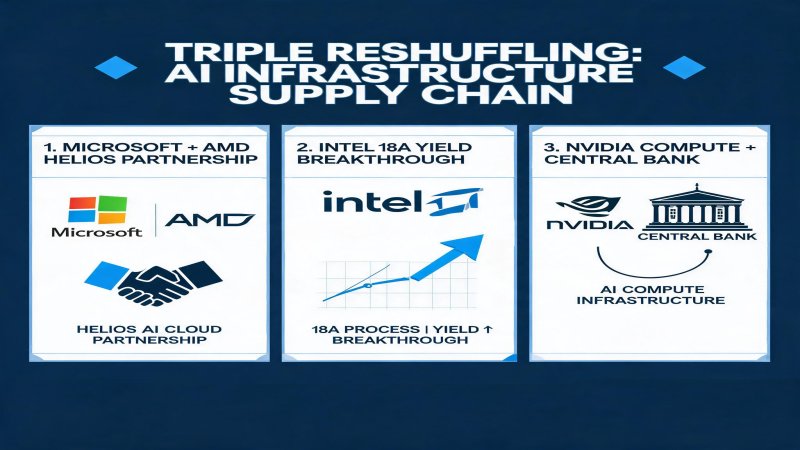
AI Infrastructure Supply Chain Restructuring: Microsoft-AMD Helios Partnership + Intel 18A Yield Breakthrough + NVIDIA Compute Central Bank — A Triple Reshuffling
VD Article Type: Deep Analysis
Publish Time: 2026-07-21 08:00 (UTC+8)
Core Vendor: Microsoft / AMD / Intel / NVIDIA / TSMC
Primary Vendor ID: 3 (AMD)
Secondary Vendors: 34 (Microsoft), 2 (Intel), 1 (NVIDIA), 39 (TSMC)
1. Event Recap
On July 20, 2026 (Beijing time), three structurally significant events hit the AI infrastructure supply chain within 24 hours:
Event One: Microsoft Azure expands AMD partnership. Microsoft officially announced deployment of AMD Helios rack-scale AI infrastructure on Azure, integrating 72 AMD Instinct MI455X GPUs per rack, paired with Venice EPYC CPUs (TSMC 2nm + SoIC 3D stacking) and Pensando DPUs. On the same day, Microsoft released three new Azure instance families built on AMD silicon: ND MI455X v7 (inference-optimized), HDv2 (CPU-intensive AI preprocessing), and HXv2 (HPC+EDA-optimized). AMD CEO Lisa Su stated explicitly that "AMD and Microsoft's multi-year collaboration is extending across the full stack of AMD AI solutions on Azure."
Event Two: Intel Foundry 18A yield breakthrough in a single quarter. A July 20 KeyBanc Capital Markets report disclosed that Intel's 18A yields jumped from approximately 65% to over 85%, a roughly 20 percentage point improvement in a single quarter. The same report disclosed that NVIDIA, AMD, Apple, Microsoft, and OpenAI have all signed 18A/14A project commitments, most as "hedge" secondary sourcing rather than primary supply. EMIB advanced packaging yields reached 90%, with EMIB-T near 98%, transforming packaging from a historical bottleneck into a selling point.
Event Three: NVIDIA invests $2 billion in CoreWeave. NVIDIA announced a $2 billion strategic investment in CoreWeave on July 20. CoreWeave, originally a cryptocurrency mining GPU operator that pivoted to AI compute rental, is a representative company in the AI cloud rental space. This investment is the first major execution case under NVIDIA's "AI Computing Partner Program" launched in early July (credit enhancement → revenue sharing → GPU buyback triple mechanism).
These three events are not isolated. From a product and technology perspective, MI455X's 432GB HBM4 and 19.6 TB/s bandwidth is AMD's direct counter to NVIDIA Rubin. From a supply chain perspective, Microsoft releasing three Azure instance families on AMD silicon on the same day marks the formal landing of the "AI chip multi-vendor strategy." From a capital perspective, NVIDIA's investment in CoreWeave signals a shift from "a hardware company that sells GPUs" to "an investment + control ecosystem for AI compute supply chain."
Together, these three events answer a core question: When AI infrastructure enters the three-dimensional competition of Total Cost of Ownership (TCO) + local controllability + supply chain resilience, who can win in the new landscape?
This article presents a six-chapter analysis covering event recap, technology depth, financial logic, strategic depth, challenges and risks, and conclusion, providing readers with a complete picture of supply chain restructuring.
2. Technology Depth
2.1 AMD Helios Rack-Scale AI Infrastructure
Helios reference design core specifications (officially confirmed 7-20):
| Component | Specification | Key Technology |
|---|---|---|
| GPU | 72x AMD Instinct MI455X | CDNA 5 architecture |
| HBM4 memory | 432GB/GPU | 19.6 TB/s bandwidth |
| CPU | AMD Venice EPYC | TSMC 2nm + SoIC 3D stacking |
| DPU | AMD Pensando | Infrastructure management / network encryption |
| Cooling | Liquid | Wider tray design for more hardware |
| Network protocol | UALoE | Open standard, cross-vendor compatible |
- ND MI455X v7 (inference-optimized): Built on Helios rack, optimized for AI Agent + search tool inference workloads
- HDv2 (CPU-intensive AI preprocessing): Up to 500 EPYC Vulcan cores + 4TB memory + 32TB flash
- HXv2 (HPC+EDA-optimized): 176 EPYC Vulcan cores + >5GHz clock + 800 Gb InfiniBand
2.2 Intel Foundry 18A Key Breakthroughs
18A node vs TSMC N2 vs Samsung SF2 comparison (KeyBanc data 7-20):
| Node | Yield | Key Feature |
|---|---|---|
| Intel 18A | 85%+ | RibbonFET GAA + PowerVia backside power delivery |
| TSMC N2 | ~90% | Industry benchmark |
| Samsung SF2 | 50-60% | Industry worst |
- EMIB: ~90% (previous generation was bottleneck)
- EMIB-T: ~98%
- Foveros 3D die stacking: 80-85%
2.3 NVIDIA Compute Central Bank Model
AI Computing Partner Program triple mechanism (launched early July, executed with CoreWeave 7-20):
- Credit enhancement: NVIDIA provides financing guarantees for AI cloud companies
- Revenue sharing: AI cloud companies share a portion of revenue with NVIDIA
- GPU buyback: AI cloud companies can sell GPUs back to NVIDIA at agreed prices
Initial execution cases:
- Sharon AI: 40,000 GB300
- Firmus: 170,000 GPUs
- CoreWeave (7-20): $2 billion investment + GPU priority supply
2.4 Four-Vendor AI Infrastructure Comparison Matrix
| Dimension | NVIDIA | AMD (Helios) | Intel (Foundry) | TSMC (Foundry) |
|---|---|---|---|---|
| Core Product | Rubin GPU + NVL72 | MI455X + CDNA 5 | 18A foundry + EMIB | N2 + CoWoS |
| AI Compute Form | GPU+CPU+DPU full stack | GPU+CPU+DPU full stack | Pure foundry | Pure foundry |
| Yield | N/A (fabless) | N/A (fabless) | 85% (18A) | 90% (N2) |
| Customer Relationship | Investment + control | Azure first customer | Hedge secondary | Primary supply |
| Strategic Position | Compute central bank | Multi-vendor challenger | Local controllability | Industry benchmark |
| Market Cap/Valuation | $5T+ | $400B+ | $130B | $900B+ |
3. Financial Logic
3.1 AMD's Azure Partnership Financial Impact
MI455X economics (based on publicly disclosed specs):
- 72 MI455X GPUs per rack
- HBM4 supply: 72 × 432GB = 31.1TB HBM4/rack
- Drives SK Hynix/Samsung HBM4 capacity expansion
- Per-rack GPU cost: ~72 × $30K-$50K = $2.16M-$3.6M
Microsoft multi-vendor strategy cost effectiveness:
- Single Azure data center cabinets: ~10,000-50,000
- GPU cost share: ~60-70%
- Multi-vendor can reduce procurement cost by 10-20%
- Estimated Microsoft annual AI infrastructure CAPEX: $80-100B
3.2 Intel Foundry 18A Financial Progress
Intel Foundry Q1 2026 financials:
- Operating loss: $2.4 billion
- Quarter-over-quarter improvement: +$72 million
- 2027 breakeven target "increasingly viewed as achievable by the market"
- 18A-P variant entered risk production (+9% performance / -18% power)
18A customer commitment revenue forecast (2027-2029):
- 18A: small volume 2027 + large scale 2028-2029
- 14A: risk production 2028 + volume production 2029
- CFO David Zinsner: Advanced packaging alone could generate "billions in revenue starting in 2027"
- Estimate: Intel Foundry revenue may reach $30-50B in 2027
3.3 NVIDIA Compute Central Bank Investment Return
CoreWeave business background:
- 2024 CoreWeave revenue: $1.9 billion
- 2025 projection: $5 billion+
- Customers: Microsoft (largest) / OpenAI / Anthropic / Cohere
- GPUs: ~250,000 NVIDIA GPUs
- Valuation: 2024 $19B → projected 2026 $40B
NVIDIA $2 billion investment return calculation:
- Investment: $2 billion (~5% of CoreWeave valuation)
- Revenue sharing expectation: CoreWeave $5B revenue × 5% share ratio = $250M/year
- GPU buyback value: ~$3-5 billion (CoreWeave 250K GPUs after 5-year depreciation)
- Strategic value: Secure major customer compute channels (Microsoft/OpenAI/Anthropic)
3.4 Four-Vendor AI Infrastructure Business Financial Comparison
| Financial Metric | NVIDIA | AMD | Intel Foundry | TSMC |
|---|---|---|---|---|
| AI-related Revenue Share | ~80% | ~30% | ~5% | ~50% |
| 2026 AI Revenue Forecast | $200B+ | $20B+ | $5B+ | $100B+ |
| Gross Margin | 75%+ | 50%+ | -20% (loss) | 50%+ |
| AI CAPEX | $50B+ | $5B+ | $25B+ | $40B+ |
| 2026 R&D Ratio | 15% | 20% | 25% | 8% |
4. Strategic Depth
4.1 AI Chip Multi-Vendor Strategy Officially Lands
Microsoft's "AI Chip Big Three" landscape:
- NVIDIA (primary): Continues to supply GB200/GB300/Rubin
- AMD (newly added): MI455X + Helios rack
- Microsoft in-house (Maia): Internal use
Drivers of multi-vendor strategy:
- Cost optimization: Break single-vendor pricing power
- Supply chain resilience: Avoid over-dependence on single foundry
- Performance diversification: Different workloads match different chips
- Geopolitics: Local controllable (Intel) + Asia foundry (TSMC) dual track
Impact on NVIDIA:
- Short-term: Microsoft procurement share drops 5-10%
- Long-term: Partially offset by "investment + control" model (CoreWeave)
- Strategy: Shift from "selling GPUs" to "investing in AI cloud ecosystem"
4.2 Rise of US Local Foundry: Political Economy of Intel 18A
CHIPS Act background:
- 2022 CHIPS Act $52.7 billion subsidy
- Goal: US local advanced process by 2027
- 18A = Only US local advanced process option
Strategic intent of 18A customer commitments:
- NVIDIA: Hedge ("don't put all eggs in one basket")
- AMD: Leverage Intel chiplet packaging
- Apple: Low-power MacBook/iPad
- Microsoft: Memory + networking chips
- OpenAI: Custom AI accelerator
Intel 18A vs TSMC Arizona:
- Intel 18A: Oregon + Arizona
- TSMC Arizona: $265 billion investment, Phase 1-3
- Both form "US local dual track"
- Apple/NVIDIA/AMD/Microsoft/OpenAI: Hedging both sides
4.3 Deep Impact of NVIDIA "Compute Central Bank" Model
Traditional GPU sales model:
- NVIDIA → Distributor → Customer
- NVIDIA earns only GPU sales profit
- Distributor earns operating profit
"Compute Central Bank" model:
- NVIDIA (investment + technology + buyback) → Distributor (operation) → Customer
- NVIDIA earns: Hardware profit + equity investment + revenue share + buyback spread
- Distributor earns: Operating profit but partially controlled by NVIDIA
Impact on competitors:
- CoreWeave valuation premium: NVIDIA investment endorsement
- Smaller clouds (Nebius/Lambda): Selectively invested by NVIDIA
- AWS/Azure: Maintain "self-built + partnership" dual line
- Meta Compute: Both competition and cooperation with NVIDIA
4.4 AI Infrastructure "Industrial Bottleneck" Layering
Layer One (solved): Compute
- NVIDIA: $5T+ market cap
- AMD: $400B+ market cap
- Solution: Continuous compute race + rapid performance improvement
Layer Two (partially solved): Power
- Nuclear revival + renewable energy
- Microsoft Three Mile Island + Amazon Talen + Google Kairos
- Data center energy efficiency optimization (liquid cooling/immersion cooling)
Layer Three (beginning to solve): Materials
- CuspAI 7-20 $450M Series B
- AI for Materials Discovery
- High-entropy alloys + photonic materials + superconductors
Layer Four (unsolved): Talent
- Global AI PhD supply tight
- US H-1B policy uncertainty
- China-US AI talent competition intensifies
4.5 China AI Infrastructure "Internal War"
Kimi K3 2.8T vs Qwen3.8-Max 2.4T:
- 7-16 Moonshot Kimi K3 released (2.8T, $3/$15)
- 7-19 Alibaba Qwen3.8-Max-Preview (2.4T, limited-time 90% off)
- Marks China AI shifting from "catching up" to "encircling"
Alibaba investment portfolio internal war:
- Alibaba invests in Moonshot + has in-house Qwen team
- Kimi K3 + Qwen3.8-Max = Alibaba internal parameter race
- Reflects China AI "involution" intensity
US AI chip export control impact:
- NVIDIA H20/H200/H100 restrictions to China
- China AI cloud shifts to domestic chips (Ascend/Cambricon/Hygon)
- Accelerates China local AI chip ecosystem
5. Challenges and Risks
5.1 AMD Helios "First Mover" Risk
Challenges:
- Microsoft is AMD AI chip's "first hyperscale customer"
- Software-hardware integration requires time to optimize
- ROCm ecosystem maturity still 2-3 years behind CUDA
- Customer "bias" against AMD GPUs is hard to break
Opportunities:
- "GPU+CPU+DPU" full stack vs NVIDIA's "GPU+CPU+DPU" full stack
- Direct comparison: MI455X 432GB HBM4 vs Rubin HBM4 capacity (similar)
- 1.6T Ethernet + UALoE open standard
5.2 Intel 18A "Hedge" vs "Primary" Dilemma
Key questions for 18A:
- Yield 85% vs TSMC N2 90% = 5 percentage point gap
- "Specific product yield" vs "general chip yield" difference
- Customer actual use vs test chip production ramp
- Can 18A-P variant solve Apple low-power needs
Long-term challenges:
- 14A 2028 risk production = miss 2026-2027 AI compute shortage window
- 18A + EMIB 90% yield > die yield = multi-die integration advantage
- Customers still use TSMC as primary, Intel is "spare tire"
- Path to 2027 breakeven target
5.3 Systemic Risks of NVIDIA "Compute Central Bank" Model
Risk One: Dual role conflict
- NVIDIA is CoreWeave's "supplier + shareholder + revenue share party + GPU buyback party"
- Conflict of interest: Want CoreWeave success (shareholder) vs want CoreWeave to buy more GPUs (supplier)
- Transparency issue: Financial disclosure needs more detail
Risk Two: AI cloud ecosystem over-control
- Investment + revenue share = de facto control
- Limits CoreWeave's independent pricing power
- May attract antitrust attention
Risk Three: AI compute oversupply
- 7-4 Meta Compute launch + 7-20 CoreWeave investment
- "AI compute oversupply" narrative continues
- NVIDIA controls "soft landing" of demand side through investment
5.4 Geopolitical Risks of Supply Chain Restructuring
China-US tech decoupling:
- US CHIPS Act + export controls
- China "East Data West Computing" + domestic substitution
- Global AI supply chain shifts from "efficiency first" to "security first"
Taiwan Strait risk:
- TSMC global advanced process 90%+ capacity concentrated in Taiwan
- Any Taiwan Strait turbulence = global AI supply chain disaster
- Promotes Intel 18A + Samsung SF2 + TSMC Arizona "three-track"
European AI sovereignty:
- EU AI Act + France/Germany AI investment
- CuspAI gets UK government investment = European AI for Science layout
- Alibaba Qwen3.8-Max + Apple Intelligence cooperation in China = regionalized AI ecosystem
6. Conclusion
6.1 Core Conclusions from 24-Hour Triple Reshuffling
Core argument: The three events on July 20, 2026 collectively mark the AI infrastructure supply chain entering a "restructuring phase."
Three dimensions of restructuring:
- AI chip multi-vendor-ization (Microsoft-AMD Helios partnership)
- US local foundry rise (Intel 18A yield breakthrough)
- NVIDIA financial ecosystem-ization (CoreWeave $2 billion investment)
6.2 Multi-Level Significance
For Enterprise CIOs/CTOs:
- AI infrastructure procurement bargaining power enhanced (multi-vendor)
- Supply chain resilience quantifiable (Intel 18A + TSMC N2 dual track)
- Total Cost of Ownership (TCO) down 10-20%
For AI developers:
- Azure ND MI455X v7 = inference cost down option
- ROCm ecosystem maturity improvement = AMD GPU usability
- Microsoft Azure ecosystem = one-stop AI development platform
For investors:
- AMD: From $400B to $500B+ growth space
- Intel: 2027 breakeven "turnaround" opportunity
- NVIDIA: From $5T to $6T "compute central bank" premium
- TSMC: Still the strongest "foundry benchmark"
For geopolitics:
- US local AI supply chain controllability enhanced
- China-US AI chip "dual track" continues
- European AI for Science begins to rise
- Global AI infrastructure enters "multi-polarization"
6.3 Investment Perspective
Short-term (3-6 months):
- AMD: Helios first deployment at Microsoft = customer milestone
- Intel: 18A yield breakthrough = valuation repair catalyst
- NVIDIA: CoreWeave investment = compute central bank model validation
- TSMC: Arizona Phase 2 = customer commitment
Mid-term (12-24 months):
- AMD MI455X market size: ~$10-15B (2027)
- Intel Foundry: 2027 breakeven + 2028 positive profit
- NVIDIA: CoreWeave + other AI cloud investment portfolio
- 18A + 14A: 2027-2029 volume production
Long-term (2-5 years):
- AI infrastructure "multi-polar supply chain": Intel + TSMC + Samsung + Rapidus
- Specialized AI chips (ASIC): Google Frozen v2 / Etched Sohu / SambaNova
- Compute TCO down 10x: Performance + yield + energy efficiency three-track optimization
- "Industrial bottleneck" layered solution: Compute → Power → Materials → Talent
6.4 Summary
On July 20, 2026, the AI infrastructure supply chain simultaneously experienced three structurally significant major events. The Microsoft-AMD Helios partnership marks the formal landing of the AI chip multi-vendor strategy; Intel 18A yield breakthrough marks the US local foundry entering the "commercializable" stage; NVIDIA's $2 billion investment in CoreWeave marks the scaled replication of the "compute central bank" model.
These three events collectively answer a core question: When AI infrastructure enters the three-dimensional competition of Total Cost of Ownership (TCO) + local controllability + supply chain resilience, who can win in the new landscape?
The answer is not a single winner, but "multi-polar co-governance": NVIDIA dominates the financial ecosystem as "compute central bank," AMD challenges the multi-vendor landscape with Helios, Intel takes on local foundry demand with 18A, TSMC continues to lead process with N2/A14, and Microsoft achieves procurement elasticity with "AI chip big three."
Key observation points for the next 12-24 months:
- AMD MI455X actual deployment scale at Microsoft
- Intel 18A "hedge" procurement volume from Apple/NVIDIA
- NVIDIA compute central bank model "replication" cases (SambaNova/Cerebras/Etched)
- Energy efficiency breakthroughs of specialized AI chips (Google Frozen v2 etc.)
- "Soft landing" process of AI compute oversupply vs shortage
The restructuring of AI infrastructure supply chain has just begun.
References
Official Announcements:
- AMD. (2026-07-20). *Microsoft Azure Expanding AI Infra Choice with AMD Helios™. https://www.amd.com/en/blogs/2025/Microsoft-Azure-Expanding-AI-Infra-Choice-with-AMD-Helios.html
- NVIDIA. (2026-07-20). *NVIDIA Invests $2 Billion in CoreWeave. https://nvidianews.nvidia.com/news/nvidia-invests-2-billion-in-coreweave
- NVIDIA. (2026-07-20). *Bristol Myers Squibb Building Life Science Industry's Most Advanced AI Factory on NVIDIA Vera Rubin*. https://nvidianews.nvidia.com/news/bms-vera-rubin-ai-factory
- NVIDIA. (2026-07-20). *At SIGGRAPH, NVIDIA Advances Graphics and Simulation With Agentic and Physical AI*. https://nvidianews.nvidia.com/news/siggraph-agentic-physical-ai
- NVIDIA. (2026-07-21). *NVIDIA Cosmos 3 Edge on Hugging Face*. https://huggingface.co/blog/nvidia/cosmos3edge
Analytical Reports:
- SiliconAngle. (2026-07-20). *Microsoft will use AMD's AI-optimized Helios racks in Azure*. https://siliconangle.com/2026/07/20/microsoft-will-use-amds-ai-optimized-helios-racks-azure/
- rcrtech. (2026-07-20). *Intel Foundry's 18A yields reportedly surge as Nvidia, AMD, Apple sign on*. https://rcrtech.com/semiconductor-news/intel-foundry-18a-yields/
- TheNextGenTechInsider. (2026-07-21). *Microsoft Prepares Project Perception AI Security Product*. https://www.thenextgentechinsider.com/pulse/microsoft-prepares-project-perception-ai-security-product
- TechStartups. (2026-07-20). *Top Tech News Today, July 20, 2026*. https://techstartups.com/2026/07/20/top-tech-news-today-july-20-2026-alibaba-bezos-blackstone-google-moonshot-ai-nvidia-samsung-more/
- Hipther. (2026-07-21). *AI Dispatch: TSMC Arizona, CuspAI, Nvidia, Apple, Google Gemini, ChatGPT and Anthropic – July 20, 2026*. https://hipther.com/latest-news/2026/07/20/115375/ai-dispatch-tsmc-arizona-cuspai-nvidia-apple-google-gemini-chatgpt-and-anthropic-july-20-2026/
Why it Matters
This 24-hour triple reshuffling is the core narrative of the 2026 AI infrastructure: (1) 'AI chip multi-vendor-ization' formally lands, with Microsoft releasing 3 AMD-based Azure instance families on the same day, marking the end of 'NVIDIA dominance' + AMD/Intel/TSMC/Google in-house forming multi-polar competition; (2) 'US local foundry rise' breaks the critical point, Intel 18A yield 85% + EMIB 90-98% = US local advanced process commercializable, TSMC Arizona + Intel 18A + Samsung Texas = 'US local three-track'; (3) 'NVIDIA compute central bank' model scales in replication, extending from CoreWeave to SambaNova/Cerebras/Etched and other emerging AI clouds, NVIDIA shifting from 'selling GPUs' to 'controlling AI compute supply chain'; (4) 'AI infrastructure industrial bottleneck' layering clarifies: compute (solved) → power (partially solved) → materials (CuspAI beginning) → talent (unsolved); (5) 'China-US AI dual track' deepens, domestic chips (Ascend/Cambricon/Hygon) benefit from export controls, Kimi K3 + Qwen3.8-Max 2T+ parameters challenge Fable 5. Systemic impact: Investors / Hyperscaler CTOs / AI chip vendors / Chinese AI ecosystem / Geopolitics.
DECISION
- Investors: AMD (AMD.US) directly benefits, Helios first deployment at Microsoft = customer milestone + multi-vendor landscape driving AI chip demand; NVIDIA (NVDA.US) short-term pressure (Microsoft share 5-10% taken), but CoreWeave investment offsets + compute central bank model premium; Intel (INTC.US) 18A yield breakthrough + 2027 breakeven target = valuation repair catalyst; TSMC (TSM.US) remains industry benchmark but US local dual track squeezes Asia single supply; CuspAI and other AI for Materials companies are new 'materials bottleneck' layer investment opportunities
- Hyperscaler CTOs/CIOs: Within 30 days evaluate 'AI chip multi-vendor' procurement strategy (NVIDIA primary + AMD secondary + in-house Maia supplementary); evaluate inference cost advantage of Microsoft ND MI455X v7; establish 'Helios+Azure Boost' + Azure ND Blackwell hybrid deployment strategy; evaluate HXv2 instance applicability for HPC+EDA workloads
- AI Chip Vendors: Evaluate market positioning of AMD MI455X 432GB HBM4 vs NVIDIA Rubin HBM4; promote HBM4/CoWoS long-term contracts (SK Hynix/Samsung); evaluate impact of energy efficiency breakthroughs of specialized AI chips (Google Frozen v2 etc.) on general-purpose GPUs; enhance Intel Foundry external order capacity (18A + EMIB = multi-die integration advantage)
- Chinese AI Ecosystem: Benefits from export controls + Kimi K3/Qwen3.8-Max open-source challenge; promote full-stack adaptation of domestic AI chips (Ascend/Cambricon/Hygon) with Kimi K3; evaluate cooperation opportunities with overseas AI for Materials companies like CuspAI
- Regulators/Policy: Monitor antitrust risk of NVIDIA compute central bank model (triple identity of investment + revenue share + buyback); monitor impact of AI infrastructure supply chain restructuring on 'AI bubble' assessment; monitor national strategic value of CuspAI and other AI for Materials companies; monitor impact of China-US AI chip 'dual track' on global AI governance
PREDICT
- 7-22: AMD Advancing AI 2026 conference (San Francisco), expected to disclose more MI455X details + Venice EPYC release timeline
- 8-15: Microsoft ND MI455X v7 instance GA timeline, AMD Azure cooperation specific scale
- 9-15: Intel 18A actual 'hedge' procurement volume assessment from Apple/NVIDIA, 2027 breakeven path validation
- Within 12 months: NVIDIA compute central bank model 'replication' cases (SambaNova/Cerebras/Etched etc.), NVIDIA investment portfolio scale
- Within 12-24 months: 18A + 14A volume production + EMIB becomes new advanced packaging benchmark; Kimi K3 + Qwen3.8-Max 2T+ parameter models continuously challenge closed-source frontier; CuspAI and other AI for Materials companies begin commercialization; Google Frozen v2 2028 production roadmap; Chinese AI ecosystem 'independent path' further deepens
Get 3-5 key AI infrastructure signals weekly →
💬 Comments (0)